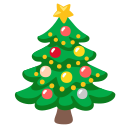
🎄 is a decorated Christmas tree. It has been in Unicode since 6.0 in 2010 and is the classic seasonal emoji: its use rises sharply as December approaches, then nearly vanishes after the 25th. For most people it points to the holiday season, gifts and time with family more than to a religious meaning.
How it’s used
- Greetings: “Merry Christmas 🎄”
- Showing off decorations: “Tree is finally up 🎄”
- Planning gatherings: “Dinner on the 24th? 🎄”
- Gift talk: “What do you want for Christmas? 🎄🎁”
- Countdowns: “One week until Christmas 🎄”
It often travels with 🎅 (Santa), 🎁 (gift), ⛄ (snowman) and ❄️ (snowflake). 🌲 (evergreen tree) has no decorations and says forest or camping. For New Year’s, 🎆 fits better.
Korea, Japan and the English-speaking world
In English, 🎄 is the standard shorthand for putting up the tree, wrapping presents and family gatherings. It appears in “Merry Christmas” as well as the broader “Happy holidays.” For people who do not celebrate Christmas, or in mixed workplaces, ❄️ or ✨ is a more neutral winter greeting.
In Korea, December 25 is a public holiday, and the image mixes couples’ plans, family time and year-end parties. 🎄 turns up in self-teasing “solo Christmas” jokes as well. Cafés and malls start decorating early, so some people use the emoji from late November.
In Japan, December 25 is a regular working day. The mood centers on Christmas Eve for couples, Christmas cake and fried chicken, and the emoji, known as クリスマスツリー, carries little religious weight. After Christmas the decorations swap quickly for New Year items such as the 🎍 kadomatsu, so from the 26th the emoji nearly disappears.
Where it gets misread
- It is not 🌲 (evergreen tree) or 🌳 (deciduous tree). The decorations and star make it Christmas.
- Some people mistake it for 🎋, the bamboo of Japan’s Tanabata festival.
- With someone who does not celebrate Christmas it can feel awkward. ✨ or 🎁 is a safer year-end gesture.
- Some people use it from late November, but after early January it feels out of season.
Design differences by platform
The basic design is shared: a green cone-shaped tree, ornaments and a star on top. The color and number of ornaments differ. Apple’s has colorful baubles and feels festive, while Google’s Noto is closer to a simple shape. Microsoft’s Fluent is three-dimensional, and Samsung’s ornaments are crisp in color. Some designs include extras like presents, so the amount of detail varies noticeably.