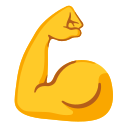
💪 shows an arm bent so the bicep bulges, the classic strongman pose. It came in with Unicode 6.0 in 2010 and originally meant exactly what it shows: strength. These days it is just as likely to mean willpower as muscle. “I can do this” and “you can do this” both fit in the same tiny arm.
How it’s used
- Workout post: “Leg day done. Never again 💪”
- Resolve: “Finishing this draft by Friday 💪”
- Encouragement: “Good luck with the interview, you’ve got this 💪”
- Offering to help: “I’ll carry that for you 💪”
- Victory lap: “Finally paid off the last of my loans 💪💪”
✊ (raised fist) is solidarity and defiance, while 💪 starts from the body: strong, tough, capable. The two often show up side by side in motivational posts, along with 🔥.
Korea, Japan and the English-speaking world
In English, 💪 sits at the intersection of gym culture and self-confidence. It tags every fitness post, but it also carries the “flex” in its name, which means showing something off, so it can be sincere pride or tongue-in-cheek bragging. It is tied to the “We Can Do It!” poster image too, and shows up in posts about women’s independence and resilience. Plain encouragement (“You’ve got this 💪”) is just as common.
In Korea it is called 알통 (“bicep”) and works as the emoji companion to 화이팅, the all-purpose cheer. People attach it to “힘내” before exams, interviews or late shifts, and to gym check-in posts. Said to a senior, though, it can feel like you are the one cheering them on, so some people avoid it with superiors.
In Japan, 力こぶ appears in phrases like 「頑張るぞ💪」 (I’ll do my best), 「任せて💪」 (leave it to me) and 「筋トレ完了💪」. It carries a sense of 気合い, getting yourself fired up, and also fits a casual 「ファイト!」 to a friend. As in Korea, it covers both resolve and cheering others on.
Where it gets misread
- Replying to someone’s achievement with “I did that too 💪” can sound like a brag. The arm is a flex, and people notice.
- It can also read as a challenge, “come at me,” which makes a heated argument worse.
- Sending only “hang in there 💪” to someone who is ill or struggling can feel glib. Ask how they are first and use the arm only after a real sentence.
- It isn’t 🦾 (mechanical arm) or 🏋️ (weightlifter). It’s a bare arm, and the broader meaning is effort, not specifically lifting.
Design differences by platform
There are skin-tone variants alongside the default yellow. Apple’s arm has realistic muscle shading, Google’s Noto version is rounder and simpler, and Microsoft’s Fluent has a pronounced three-dimensional look. Samsung’s outline is on the soft, cartoonish side. How thick the arm looks and how much the bicep bulges differ a little, so some versions look brawny and others cute, but the meaning stays the same.