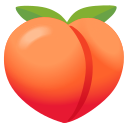
🍑 is a pink-orange peach with a green leaf. It has been in Unicode since 2010, inherited from Japanese phone emoji, and the plain meaning is the fruit: summer, sweetness, pies, cobbler, iced tea. But few emojis have been bent as far from their dictionary meaning as this one. Thanks to its rounded shape and the cleft down the middle, it became a common internet shorthand for a person’s backside, which means readers have to judge from the surrounding message which one is meant.
How it’s used
- Seasonal fruit: “First peaches of the summer and they are unreal 🍑”
- Baking and cooking: “Peach cobbler is in the oven 🍑”
- Gifts and groceries: “A basket of Georgia peaches arrived today 🍑”
- Affection: “You’re such a peach for helping me move 🍑”
- Color and style: “Peachy blush, my new favorite shade 🍑”
Compared with 🍊 and 🍎, 🍑 suggests soft skin and a juicy bite. It often keeps company with 🍒 and 🍓 in dessert and summer-fruit posts.
Korea, Japan and the English-speaking world
In English, there are two readings. One is wholesome: “You’re a peach” means someone is lovely, “peachy” means great, and Georgia is nicknamed the Peach State. The other is the online innuendo about the backside, which is why 🍑 is often paired with 🍆 in jokes. A fruit blogger posting to an international audience may add the word “peach” in the caption to make the intent clear.
In Korea, the first association is summer fruit: white peaches, yellow peaches, and the nectarine-like 천도복숭아. Peaches are linked to the immortality peaches of folklore and to the blossoming land of 무릉도원, and there is a custom of leaving them off the ancestral memorial table because they are believed to keep spirits away. The ankle bone is even called “peach bone” (복숭아뼈).
In Japan, 桃 evokes the folk hero Momotaro, the Peach Festival (Hinamatsuri) on March 3, and the old myth in which Izanagi drove away demons by throwing peaches. White peaches from Okayama or Yamanashi are prized gifts. As an emoji it is nearly always used literally, for fruit, desserts and peach-flavored drinks.
Where it gets misread
- On English-language social media it may be read as a bawdy joke. If your account has an international audience, make it clear you mean the fruit.
- Some platforms restrict posts that use it in a sexual context. For fruit-shop ads, adding a plain description is the safest approach.
- Paired with 🍆, it will almost never be read as a produce-aisle message.
- It does not distinguish between a flat peach, a nectarine or a regional variety, so say so in words if the type matters.
Design differences by platform
All platforms show a pink-to-orange fruit with a green leaf, but they differ in how deep the cleft is, how many leaves there are and which way they point, and how saturated the color is. Apple’s peach is rounded and glossy, Google’s Noto is cleaner and more graphic, and Microsoft’s Fluent uses soft shadows. Samsung’s is similar with slightly different contrast. Some platforms have softened the cleft so that it reads as a fruit rather than anything else.