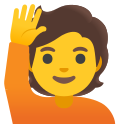
🙋 is a person holding one hand high in the air. People call it the “me!” emoji or the hand-raise emoji. It entered Unicode 6.0 in 2010 as “happy person raising one hand,” originally drawn as a woman on most platforms; today the base version is gender-neutral, with 🙋♀️ and 🙋♂️ as explicit variants. The gesture is the classroom one: “I’m here,” “me too,” “I have a question.” It is an active, eager signal.
How it’s used
- Volunteering: “Who’s free Saturday?” → “🙋”
- “Same here”: “Am I the only one still at the office? 🙋”
- Asking a question: “🙋 Could you go over that part once more?”
- Introductions: “New hire here 🙋 nice to meet everyone”
- Quick polls: “Option A 🙋 Option B 🙆”
👋 is a greeting; 🙋 is participation. ✋ is a bare hand and can read as “stop” or a high five, while 🙋 shows the whole person and clearly means “I volunteer.” 🙆 and 🙅 are the arm-circle “OK” and crossed-arms “no” gestures, which are answers rather than hands raised.
Korea, Japan and the English-speaking world
In English it is the emoji of “who’s in? 🙋” and “me! 🙋♀️,” and it is welded to the phrase “raise your hand if…” Social posts invite agreement with “Raise your hand if you’ve ever… 🙋” and replies come back as a single raised hand. Customer-service accounts also use it to signal availability: “Questions? 🙋 We’re here.” In work chat it softens “I have a question” nicely.
In Korea it is the standard head-count tool in group chats. A question like “Who’s coming to dinner 🙋” or “Anyone know how to do this 🙋” prompts a reply of just 🙋. There is also a self-deprecating “that’s me” usage on relatable posts (“People whose diet starts tomorrow 🙋”). In workplace messengers it is a gentle way to open with a question.
In Japan the name is 手を挙げる人 (person raising a hand) and it reads as はい!(“yes, me!”). It appears in Twitter posts fishing for agreement (“people who do this 🙋♀️”) and when joining a Q&A segment on a livestream. Japanese users tend to pick a gendered variant, and the female version shows up more than the neutral one. Shop and service accounts use it in a hospitality tone: “Questions this way 🙋.”
Where it gets misread
- Depending on context it means either “I have a question” or “I’ll do it.” In work chat, add words: “🙋 one question.”
- It is easily confused with 💁 (person tipping hand), the palm-out “information desk” pose that English speakers read as sassy. The hand straight up is 🙋.
- 🙆 and 🙅 are yes/no answers made with the arms; 🙋 is “count me in.” Mixing them as poll options can muddle the vote.
- With skin-tone and gender variants, the default look differs across devices and apps. If you don’t want to specify gender, use the plain 🙋.
Design differences by platform
Apple shows a smiling, open-mouthed figure with the palm facing forward, giving the most eager “me!” energy. Google’s Noto version has a simpler face and a smaller hand, reading calmer. Microsoft’s Fluent figure is dimensional with the arm fully extended, closest to a real classroom hand-raise. Samsung at one point drew the figure winking, which made it look like a playful volunteer. Since the base became gender-neutral most platforms use an androgynous hairstyle, but older devices and some apps may still default to a woman.