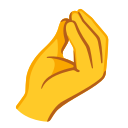
🤌 is a hand with all the fingertips gathered together and pointing upward. It was added in Unicode 13.0 in 2020 as “pinched fingers.” In Italy the gesture goes with “ma che vuoi?” (“what do you want?”), “what are you saying?” or “are you kidding me?”, and it adds exasperation or disbelief to whatever is being said.
How it’s used
- Playful Italian sass: “Pineapple on pizza? Ma che vuoi 🤌”
- Disbelief: “Is that seriously your argument? 🤌”
- Food praise: “This pasta is perfection 🤌”
- Casual shrug: “It’s fine, it’s whatever 🤌”
- Emphatic explaining: “What I mean is, it’s not like that 🤌”
Using 🤌 for “delicious” or “perfect” is a newer English-language twist, helped by its resemblance to the “chef’s kiss” gesture. It isn’t the gesture’s original meaning.
Korea, Japan and the English-speaking world
In English, 🤌 is widely treated as the Italian hand, tied to the “ma che vuoi” line and to a whole genre of memes that imitate Italian-American speech. It is also used for praising food and for ironic annoyance. Some people take care that it doesn’t come off as a caricature of Italians.
In Korea, people who know it from Italian films and meme videos recognise it, but few use it in everyday chat. Since the gesture isn’t native there, some read it as “just a little” or as pinching something. If you use it, make the joke obvious from context.
In Japan the name 上向きにすぼめた手 simply describes the hand shape, and the link to an Italian gesture is not widely known. Some Japanese speakers read the pinched shape as ちょっとだけ (“just a little”) or つまむ (“to pick up”). It turns up mostly around Italian food and mock-Italian jokes.
Where it gets misread
- It is not 🤏 (pinching hand), where thumb and finger come together to mean “a tiny bit.” 🤌 gathers all the fingertips upward.
- It is not 👌 (OK hand). 🤌 does not form a circle, and its basic mood is disbelief, not approval.
- To a friend who isn’t Italian, it can look like you’re mocking an accent. Keep it to affectionate jokes.
- The name “pinched” suggests nipping or touching someone, but that has nothing to do with the gesture. Don’t read it that way.
Design differences by platform
The basic shape, all fingertips together and aimed up, is similar on every platform. Apple’s fingers meet neatly with a slight tilt of the wrist, Google’s Noto is rounder and simpler, Microsoft’s Fluent has pronounced shading and depth, and Samsung typically draws the fingertips distinctly. Skin-tone variants and hand angle differ, so the same 🤌 can feel a little different from device to device.