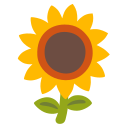
🌻 is a sunflower: yellow petals around a large brown seed head. It was one of the first flower emoji, added in 2010, and if 🌸 (cherry blossom) is spring and 🍁 (maple leaf) is autumn, 🌻 is summer. Its base feeling is warmth, cheer and positivity, but depending on where you are it has picked up extra layers, from unwavering love to political solidarity to a quiet request for patience, which makes it one of the more loaded flowers on the keyboard.
How it’s used
- Summer and sunshine: “Finally on holiday 🌻☀️”
- Cheerful encouragement: “Hope your day is as bright as this 🌻”
- Garden and allotment updates: “This year’s sunflowers hit two meters 🌻”
- Solidarity: next to 🇺🇦 in posts about Ukraine, or in a display name
- Hidden disability: in bios or posts about the Sunflower lanyard scheme
Where 🌼 (blossom) and 🌸 feel small and delicate, 🌻 is big and confident. 🌹 (rose) points straight at romance; 🌻 is more like steady, loyal affection, especially in East Asia.
Korea, Japan and the English-speaking world
In English the default reading is simply “sunshine,” a happy flower for happy posts. Two specific meanings sit on top of that. Since 2022 the sunflower, Ukraine’s national flower, has become a widely understood symbol of support, often paired as 🌻🇺🇦 in profile names and captions. Separately, the Hidden Disabilities Sunflower, a lanyard scheme that began at a UK airport and has spread to shops, transport and other countries, uses the flower to mean “I have a non-visible condition and may need extra time or help.” Many British readers will see 🌻 and think of that first. In the US it is also the state flower of Kansas and a common motif in boho and farmhouse aesthetics.
In Korea the name 해바라기 literally means “sun-gazer,” and the first association is a flower that looks only at one thing. It is the flower of one-sided crushes, devotion and “I only have eyes for you,” and fans use it to say they are loyal to a single idol. A folk belief that sunflower paintings attract wealth also makes it show up in congratulations for new shops or new homes.
In Japan ひまわり is practically a season word for summer, alongside cicadas and the beach, and it carries a childlike, wholesome image: many nurseries and schools are named after it. The flower language “あなただけを見つめる” (“I look only at you”) matches the Korean reading, so the romantic nuance carries over. Sunflower-planting projects in areas hit by the 2011 earthquake and tsunami also gave it a note of recovery and hope.
Where it gets misread
- A 🌻 in someone’s display name is very likely a political statement about Ukraine, not a gardening hobby. Don’t assume it is decorative.
- The Korean and Japanese “you are my only one” meaning does not travel into English. Sent to an English speaker, it reads as friendly and bright, not as a confession.
- It is easy to confuse with 🌼 (blossom), which is a generic small flower. On some platforms both are yellow and hard to tell apart at small sizes.
- The large, textured seed head bothers people with trypophobia. A long row of 🌻🌻🌻 is best avoided.
Design differences by platform
Apple’s sunflower has two overlapping rings of petals and a textured seed head, making it the most realistic. Google’s Noto design is flat and clean, with fewer petals and a proportionally large brown center. Microsoft’s Fluent version has pointed petals and a slight 3D feel that makes it look like a character, while Samsung’s is a bright yellow bloom with a clearly drawn green stem and leaves. All platforms include a stem, but its length varies: Apple and Samsung look like a single cut flower, while Google reads more as a flower face.