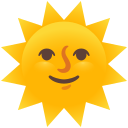
🌞 is a sun with rays all around and a smiling face in the middle. It came in with Unicode 6.0 in 2010 as part of a small family of celestial bodies with faces, alongside 🌝 (full moon face) and 🌚 (new moon face). The official name is “sun with face,” and people also call it the “smiling sun.” It says less about the weather and more about a bright mood, a warm personality or a summer state of mind.
How it’s used
- Morning greetings: “Good morning, sunshine 🌞”
- Encouragement: “You’ve got this interview today, go shine 🌞”
- Vacation posts: “First day of summer break 🌞”
- Praising a warm person: “She walks into a room and it feels like 🌞”
- Day and night pairs: 🌞 for “good morning,” 🌝 or 🌚 for “good night”
If you only want to say the weather is clear, ☀️ is plainer. The face on 🌞 adds the idea of “I’m in a good mood.” Compared with 😊, a human smile, the sun face feels more energetic and radiant.
Korea, Japan and the English-speaking world
In English, 🌞 pairs naturally with “good morning, sunshine,” “rise and shine” and “good vibes only.” It decorates vacation photos, summer captions and bios of people who describe themselves as sunny. It is also used sarcastically for forced cheer, as in “Monday again 🌞,” and it gets paired with 🌝 for day-and-night jokes.
In Korea, the emoji fits neatly into the culture of morning greetings in group chats and family threads, where a cheerful good-morning often ends with a sun. For heat, Koreans usually choose ☀️ or 🥵 instead, while 🌞 stays on the warm, positive side.
In Japan the name 顔のある太陽 (“sun with a face”) is literal. It appears in greetings like “おはよう🌞,” and it suits a summer greeting card season such as 暑中見舞い, but for plain weather talk the standard choice is ☀️ or the word 晴れ.
Where it gets misread
- It is not the same as ☀️. The plain sun is a weather symbol, while 🌞 is a greeting with a mood. For a forecast, use ☀️.
- A face on the sun does not mean a person is hot. For heat, use 🥵.
- In a conversation about bad news, 🌞 can look flippant.
- In English, forced positivity can turn it into sarcasm, so read the context before taking it at face value.
Design differences by platform
Every platform keeps the same recipe: a yellow face ringed with rays. They differ in the shape and number of rays and the size of the expression. Apple and Microsoft use shading and a more three-dimensional look, Google’s Noto is flatter and simpler, and Samsung draws it round and soft. That means the same 🌞 can look like a wide beam on one phone and a gentle smile on another.