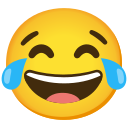
😂 means “so funny I’m crying.” When Oxford Dictionaries picked an emoji as its Word of the Year for the first time in 2015, this was the one, and it held the title of the world’s most-used emoji for years afterwards. Being that common is both its strength and its problem.
How it’s used
- Reacting to a funny photo or video: “😂😂😂” on its own is a complete reply.
- Laughing at yourself: “Got on the train going the wrong way 😂”
- Softening something that might land hard: “Yeah no, that’s not happening 😂”
Stacking two or three means “genuinely funny”; a single one is closer to a polite chuckle.
Korea, Japan and the English-speaking world
In Korea the default laugh is typed, not drawn: ㅋㅋㅋ (the sound of laughter). 😂 is usually added after it as an intensifier, so “ㅋㅋㅋ😂” is one notch funnier than ㅋㅋㅋ alone. Sent by itself, 😂 can read as slightly formal or older.
In Japan the official Unicode name translates as “crying with happiness,” and a fair number of people read it that way: moved to tears rather than laughing. Everyday laughter is more often written with 笑, w or 草, and 😂 is saved for bigger reactions.
In English, from around 2020 teenagers and twenty-somethings started calling 😂 the “parent emoji” and switched to 💀 (“I’m dead”) and 😭 (laughing so hard I’m sobbing). Among people over thirty, and in work chat, 😂 is still the standard laugh.
Where it gets misread
- The tears make some people read it as sadness, especially at small sizes or in monochrome where it blurs into 😢. Avoid it in conversations where someone needs comfort.
- Replying 😂 to someone’s mishap can read as laughing *at* them. Check that they told the story as a joke first.
- It is often confused with 🤣 (rolling on the floor laughing), which is tilted sideways and more exaggerated.
Design differences by platform
Apple’s version has eyes squeezed shut, head slightly tilted and big tears streaming from both eyes, so it looks the most like “laughing until I cry.” Google’s Noto design faces straight ahead with a wide-open mouth and feels brighter; Microsoft’s Fluent version is glossy and three-dimensional, which makes the tears stand out. Samsung once had a distinctive design with raised eyebrows before moving closer to everyone else in 2018. The two tear streaks and the grin are present on every platform, so the meaning doesn’t change between devices.